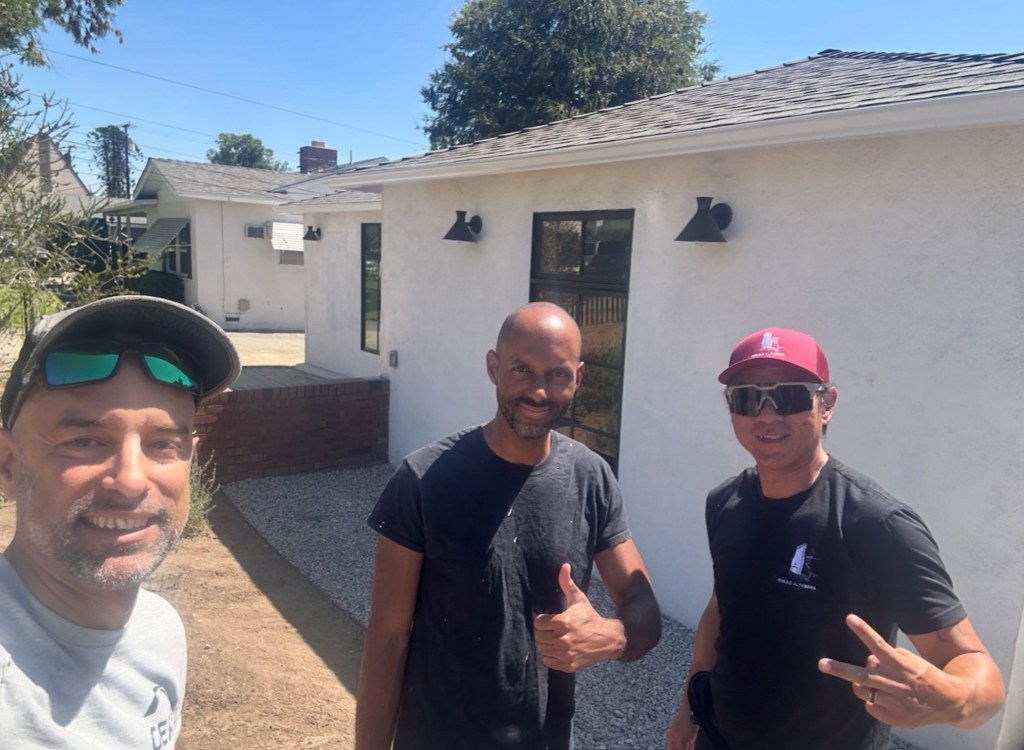
As an international humanitarian response professional, my work has taken me from Accra to Antananarivo, and from Bishkek to Zanzibar. As part of the international system of governments and organizations that helps people survive disasters and wars around the world, I’ve had the privilege of bringing life saving supplies, medical care and safe transportation to people across the globe.
My last month working in Los Angeles with an NGO called Global Emergency Relief Recovery and Reconstruction (GER3) was my first professional experience in this field helping my fellow Americans. In some ways it was a professional homecoming to work on wildfire recovery. Here are a few observations about my work on the aftermath of the 2025 Eaton Fire in Pasadena, California:
The climate crisis is real, but we can do a lot to prepare
The climate crisis is real and is accelerating. Wildfires have always been a part of life in California. But the total area burned each year is increasing, with increasingly large wildfires across the state.
Walking around the burned area in Altadena, it is easy to see the fragility of the small, well-crafted wooden bungalows that once stood on these streets in such close proximity to the steep, arid mountains looming just beyond the edge of the burned lots.
It’s also easy to see the allure of this area. The dry air is cooler up near the mountains than the smog-drenched metropolis of LA down below. Ready access to hiking trails and a slower paced life where mountain lions and bears wander into yards with regularity makes this place special.
Folks that rebuild their houses after the fire have to make them stronger and better to withstand future fires. The NGO is there helping homeowners with intact houses to prepare their structures to resist and survive the next burn. This means covering all vents and other openings with a specialized mesh that prevents wind blown embers from getting into the house and igniting the structure. It also means thinning and removing brush, trees and fences near each house to create “defensible space” of dirt and gravel around the home.
These measures will never completely protect a house during a megafire, but they do buy time and space for fire fighters to arrive and control the blaze. These ‘home hardening’ measures offer a way for people who live in the area to think about and prepare for the reality of living with wildfire. It is one of many things that people can do to deal with the trauma of the last fire and prepare for future disasters.
Displacement happens in America but we don’t call it that
Many people who lost their homes in the Eaton fire were forced to leave the Altadena area. Some dispersed to other states to stay with relatives. Others were forced to drive one or more hours away to be able to afford rental accommodations in Los Angeles’ high priced housing market.
Some estimates put the total number of displaced Americans at 11 million, about 1% of the overall population. In Sudan, these folks would be classified as ‘Internally Displaced People’. In America, we don’t think of the challenge in terms of displacement. We categorize them as total loss fire survivors, but don’t take into account the post fire displacement as a part of the solution. The family I heard of who moved to Oregon to stay with relatives is not able to access the local information, support and aid processes directly. They must rely on friends still in the area, so there is a disconnect.
This physical location consideration as a part of the solution will be essential. Thinking of these fellow citizens as displaced and helping them where they are will be a crucial part of developing America’s ability to meet the accelerating climate crisis. Tracking and quantifying the American displacement issue is a necessary first step.
Americans at the local level are tasked with responding and preparing
Federal and state level resources to put out the fire and remove the debris of charred houses and cars were fast and effective. The cleanup was over in a few weeks. Local government and nonprofit organizations quickly became responsible for the rest of the significant recovery and reconstruction process. These organizations and systems have never encountered such a massive task. They are ill equipped and funded to coordinate, manage and rebuild from a megafire’s 250 billion dollar price tag.
While it is positive that the control and responsibility falls to locals most affected by the fire, there are surprisingly few resources, coordination structures and best practices from other fires that are evident in the reconstruction process. Local governments and non-profits appear to be on their own to reinvent the wheel and figure out the approach. Local people who lost their houses or suffered massive smoke contamination but did not burn have entered a labyrinth of insurance claims, testing schemes and contractors with few clear pathways or support.
Takeaway for all Americans: What people I talked to in Pasadena said they wish they had done before the disaster
The Video – “I wish I had a freaking video on my phone of all my stuff, just a 5 minute walk-through of my house. The insurance people keep asking for photos, I’m trying to get my friends to send me pictures of the last time they came over to my place, and the photos are just not there”, said one fire survivor who lost her house and all of her possessions. Insurance claims require documentation. Receipts get lost over the years. Photos and videos of your possessions can make a positive difference in the claims process.
The Go Bag – People in the Pasadena area also now understand the need to have a bag or suitcase packed with essential items, documents, and irreplaceable mementos. This list from the American Red Cross is a good starting point.
The Insurance Check-in – Even with insurance as a big challenge for many in America’s west, some were caught with insufficient coverage. Checking your insurance policy before a disaster hits is one of the best things you can do to prepare for climate disasters. Read the fine print. What does it cover? What would you have to pay yourself if a crisis hit your house?
Making it work for you
What are you doing to prepare for climate disasters in your area? I’d love to hear comments or drop me a line.
 Rivanna Strategy